The minimal four-double-Weyl problem
Nonmagnetic crystals require at least four conventional Weyl points, yet the symmetry conditions and material realization for exactly four charge-two double-Weyl points had remained unresolved.
Strict crystalline-symmetry constraints
A systematic analysis of nonmagnetic spinless and spinful systems shows that exactly four symmetry-protected double-Weyl points are restricted to only twenty-eight space groups, sharply narrowing the material search space.
The THRLN-C32 platform
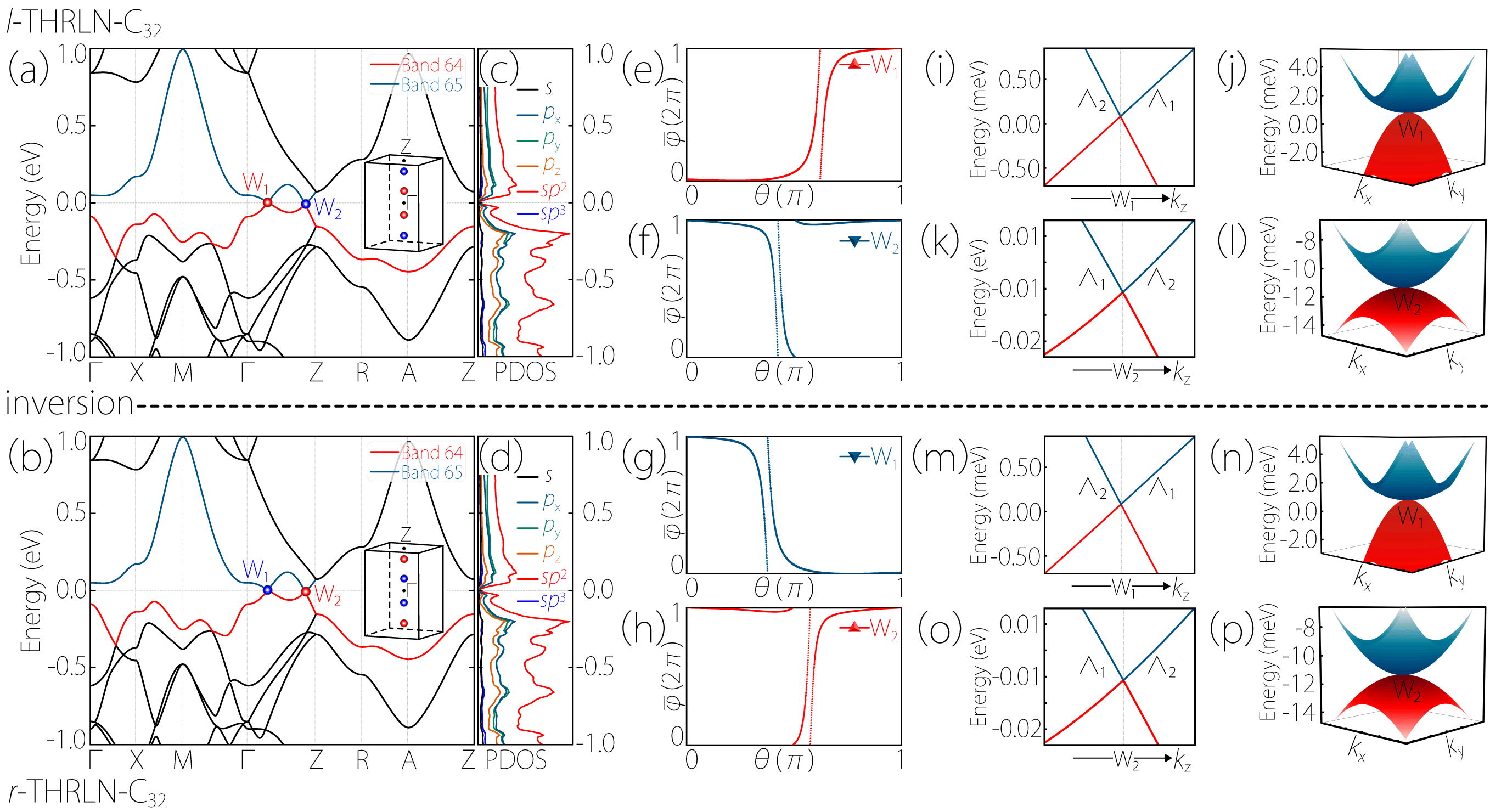
The symmetry screening identifies the sp2–sp3-hybridized chiral carbon allotrope THRLN-C32. First-principles calculations place four C4-protected double-Weyl points near the Fermi level, with extended or closed-loop Fermi arcs on the surface.
A strain-driven transition landscape
Applied strain can transform the four-double-Weyl phase into two three-terminal Weyl complexes, eight conventional Weyl points, or a fully gapped trivial insulator, yielding a unified transition landscape.
Why it matters
The study establishes the symmetry boundary and a candidate material for nonmagnetic double-Weyl semimetals while showing how strain can control complex topological node structures.