A minimal heterogeneous node pair
The total chiral charge in a crystal must vanish. The paper focuses on a minimal but heterogeneous assembly: a single charge-two Weyl point paired with a charge-two Dirac point, and systematically determines its symmetry requirements.
Magnetic-space-group classification
Across all 1,651 magnetic space groups, only fourteen without spin–orbit coupling and ten with spin–orbit coupling admit this configuration. In nonmagnetic crystals, the spinless realization is restricted to chiral space groups 92 and 96.
Chiral boron allotropes
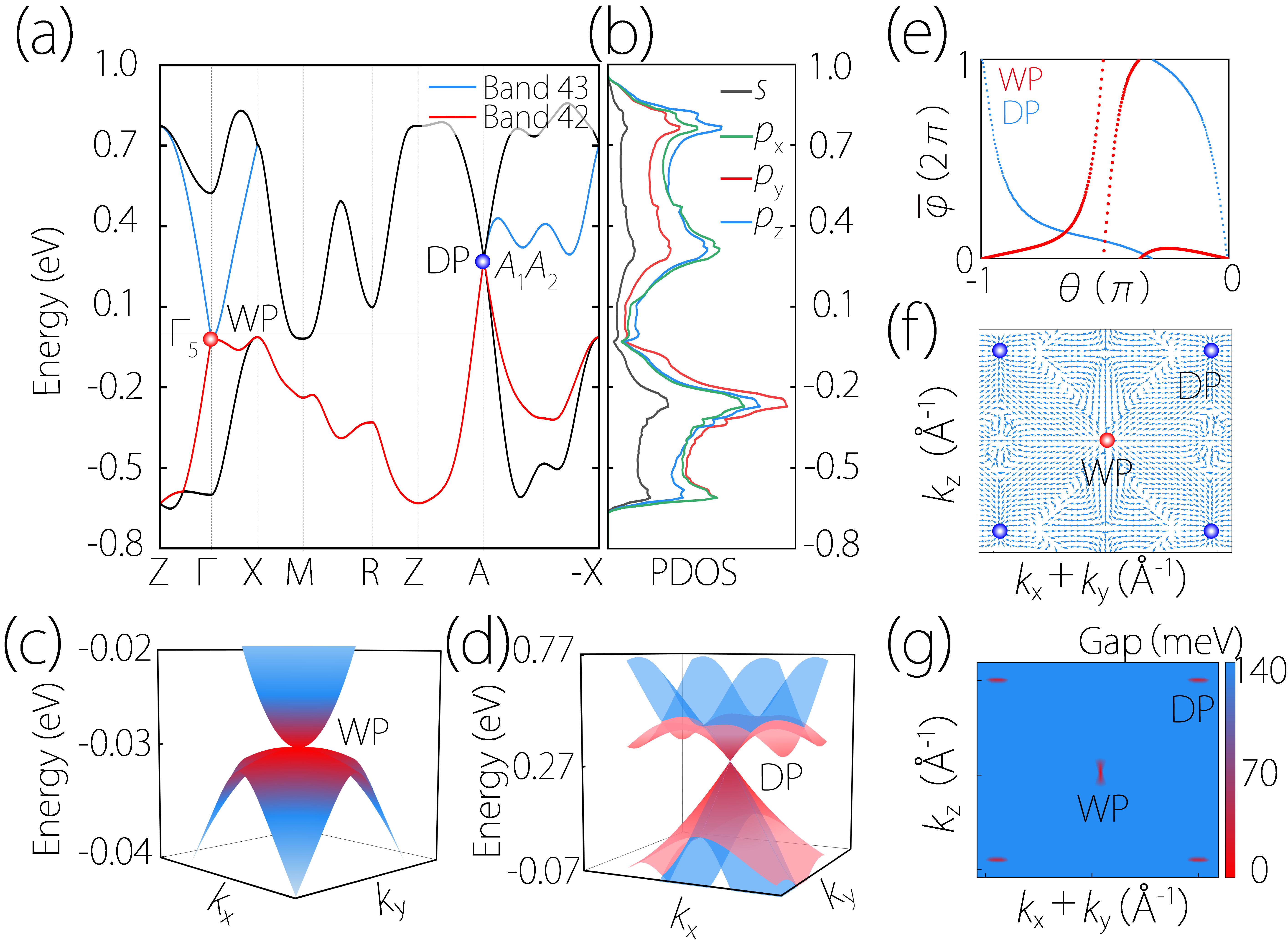
Guided by the symmetry classification, the work proposes an enantiomorphic pair of SDHBN-B28 allotropes. First-principles calculations reveal a charge-two Weyl point at Γ and a charge-two Dirac point at A as the only topological fermions near the Fermi level.
Structural chirality and surface states
The structural handedness fixes the signs of the node charges and produces two ultralong Fermi arcs spanning the surface Brillouin zone, offering a direct experimental signature.
Why it matters
The work connects a complete crystallographic classification to a concrete material platform for studying minimal heterogeneous chiral fermions and their transport responses.