Finding the building blocks of Weyl phases
Weyl points cannot exist in isolation in crystalline momentum space because the total chiral charge must vanish. The paper therefore moves from individual nodes to complete charge-neutral assemblies and asks whether a finite set of building blocks can generate every crystallographically allowed Weyl-semimetal configuration.
Sixteen irreducible Weyl molecules
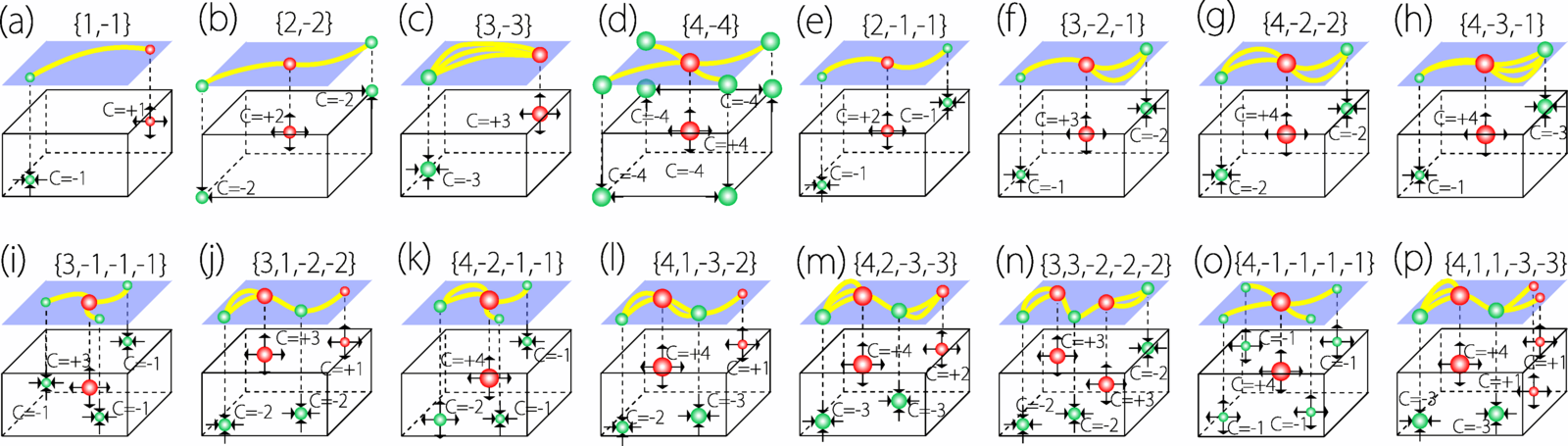
By combining minimal zero-sum chiral-charge sequences with the symmetry constraints of all 1,651 magnetic space groups, the study obtains exactly sixteen crystallographically realizable irreducible Weyl molecules: charge-neutral topological building blocks that cannot be decomposed further.
A universal linear-combination principle
For chiral charges with absolute value no greater than four, every crystallographically realizable charge-neutral node configuration can be written as a non-negative integer linear combination of the sixteen generators. This provides a periodic-table-like organization of Weyl semimetals.
Tests in materials and surface states
First-principles calculations on a family of boron allotropes show that the combination principle organizes bulk nodal configurations and constrains the admissible endpoint connectivity of Fermi arcs, while the detailed surface geometry still depends on termination, energy and inter-molecule reconstruction.
Why it matters
The classification reduces complex Weyl-node networks to a finite set of generators and their combinations, providing a unified language for identifying, comparing and designing Weyl semimetals.