From nodes to complete crystalline phases
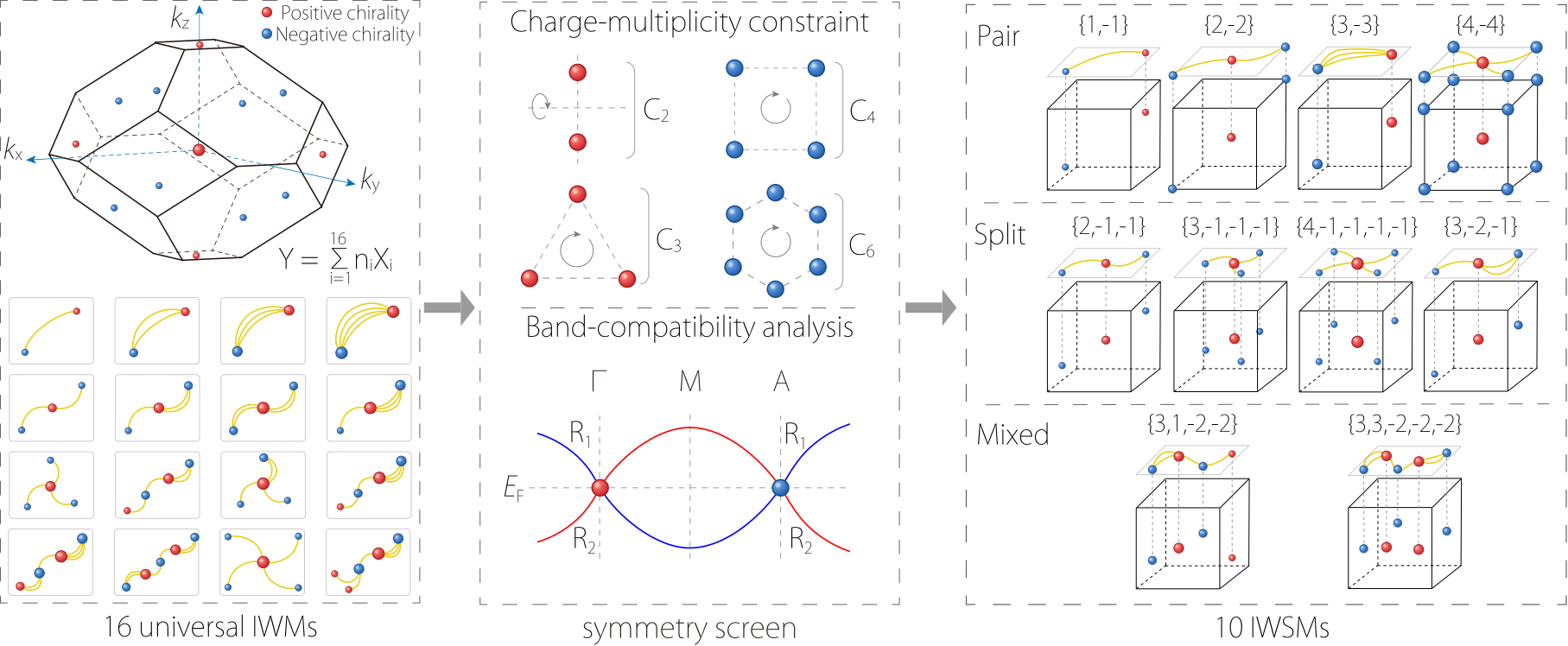
Weyl points carry quantized chiral charge, but a crystalline Weyl phase is formed by a globally charge-neutral set of nodes. Earlier work decomposed every realizable Weyl-node configuration into sixteen irreducible Weyl molecules. The remaining question was whether these indivisible building blocks could themselves form complete, standalone crystalline phases.
Three criteria
We introduce the irreducible Weyl semimetal (IWSM). An IWSM must satisfy three conditions at once: its charge inventory is primitive; complete magnetic-space-group orbits reproduce exactly one copy of that inventory; and all nodes belong to one adjacent-band pair without compatibility relations forcing additional crossings.
Classification result
Combining all 1,651 magnetic space groups with Weyl-orbit multiplicities and band-compatibility relations, we find that ten of the sixteen irreducible Weyl molecules admit one-copy standalone realizations: four Pair, four Split and two Mixed classes. The other six necessarily acquire additional Weyl nodes under crystalline symmetry.
Five previously unrecognized phases
The classification reveals five configurations not previously identified as standalone crystalline phases: {3, −3}, {3, −1, −1, −1}, {4, −1, −1, −1, −1}, {3, 1, −2, −2} and {3, 3, −2, −2, −2}. Symmetry-constrained lattice models then verify the full node inventories, Chern charges and surface chiral flow for all ten IWSM classes.
Why it matters
The work elevates Weyl minimality from local node counting to a factorization problem for complete crystalline phases, providing a symmetry-resolved framework for minimal chiral topological complexes in electronic, phononic and photonic systems.